Systems · case study
Jev RAG Benchmark
Does TypeSafe's Jev 1.13 improve a RAG pipeline? I built a free, English benchmark to find out — with frozen candidate pools, calibrated probabilities, and the runs where the hypothesis lost. This is the study of its decisions, not a feature tour.
The question
Jev 1.13 returns typed decisions with calibrated probabilities instead of text — a natural fit for one of RAG's quietest jobs: deciding which retrieved passages deserve to reach the model, and when it is safe to skip a generation call entirely. The benchmark puts Jev, a trained NVIDIA cross-encoder and the unranked hybrid order on identical frozen candidates, then asks a single question: does the model actually improve the system?
The constraints
- 01
English data only: XQuAD-EN and SciFact — no translation confound.
- 02
$0 budget. Free tiers or the benchmark does not get re-run.
- 03
Framework-neutral. The numbers must describe models, not wrappers.
- 04
Negative results stay in. Exploratory analyses say so.
The decisions
- D1
A free stack, or a more reproducible one?
- Context
- A benchmark nobody can afford to re-run is a blog post. Reranking evaluations burn tokens on every method you compare.
- Options
- Paid APIs · local models on a laptop · free tiers of hosted models
- Chosen
- Free tiers only: Vercel AI Gateway for Jev 1.13, NVIDIA NIM for embeddings and the cross-encoder, Codiv for generation.
- Why
- Every published number can be reproduced by anyone with an account and no budget approval. The whole benchmark — 1,490 reranked queries across four methods — cost $0.
- The cost
- Model churn. Three NVIDIA models were retired mid-project and had to be replaced; each swap is recorded in the run manifest so results stay attributable.
- D2
A RAG framework, or a harness of my own?
- Context
- Reranking comparisons are easy to run in LlamaIndex or LangChain — and easy to contaminate with their prompt wrappers, parsers and batching.
- Options
- Adopt a framework · build a thin harness · fork an existing benchmark
- Chosen
- A framework-neutral harness with three runtime dependencies.
- Why
- A benchmark should measure models, not wrappers. Fewer layers also means clean latency numbers — and latency is a headline claim for System One models.
- The cost
- The glue has to be written and tested: BM25, reciprocal rank fusion, metrics, calibration, export. That work is the repo.
- D3
How to keep the comparison honest
- Context
- If retrieval re-runs between methods, a lucky or unlucky draw gets published as a model difference.
- Options
- Live retrieval per method · frozen candidate pools · frozen pools plus frozen contexts
- Chosen
- Freeze the top-20 candidates once, compare every reranker on that pool, then replay generation over one frozen top-5.
- Why
- Retrieval, reranking and generation effects are separated by construction. Paired bootstrap confidence intervals compare methods on identical queries.
- The cost
- The stages cannot adapt to each other. A real system could rerank the pool differently per query; the benchmark deliberately cannot.
- D4
Publish the runs where the hypothesis loses
- Context
- Jev helps where the first stage leaves headroom. On XQuAD the baseline is already at 98.1% nDCG — and a trained cross-encoder still leads by 0.45 points.
- Options
- Report only the wins · report everything · report everything and label what came later
- Chosen
- Report everything, with a preregistered protocol and an explicit changelog that marks later analyses as exploratory.
- Why
- A benchmark's credibility comes from the runs where its hypothesis loses. 'No measurable difference' is a finding, not a failure.
- The cost
- The headline is less shiny, and later additions had to carry an honest 'exploratory' label instead of being framed as confirmatory.
- D5
Always-on reranking, or confidence-gated decisions?
- Context
- Ranking every candidate by independent probabilities is noisy. The model's own calibration offered a different interface.
- Options
- Always-on reranking · all-or-nothing switching · confidence-partitioned decisions
- Chosen
- Keep candidates with p ≥ 0.5 in the model's order, fall back to the hybrid order for the rest; skip generation entirely when the top probability is low.
- Why
- The decision layer beat the unranked baseline on both datasets (+0.89 pts XQuAD, +4.14 pts SciFact), and answerability gating removed 9.8% of generation calls while raising answer F1.
- The cost
- A threshold must be chosen, documented and re-validated per domain. Gating is a policy, not a property of the model.
The result
nDCG@10 on identical frozen top-20 candidates. A = no reranker (hybrid order), T = TypeSafe Jev 1.13 batch noul, N = NVIDIA cross-encoder.
| Dataset | n | A · no reranker | T · Jev 1.13 | N · NVIDIA |
|---|---|---|---|---|
| xquad-en | 1190 | 98.11% | 98.93% | 99.37% |
| scifact | 300 | 71.67% | 79.29% | 78.70% |
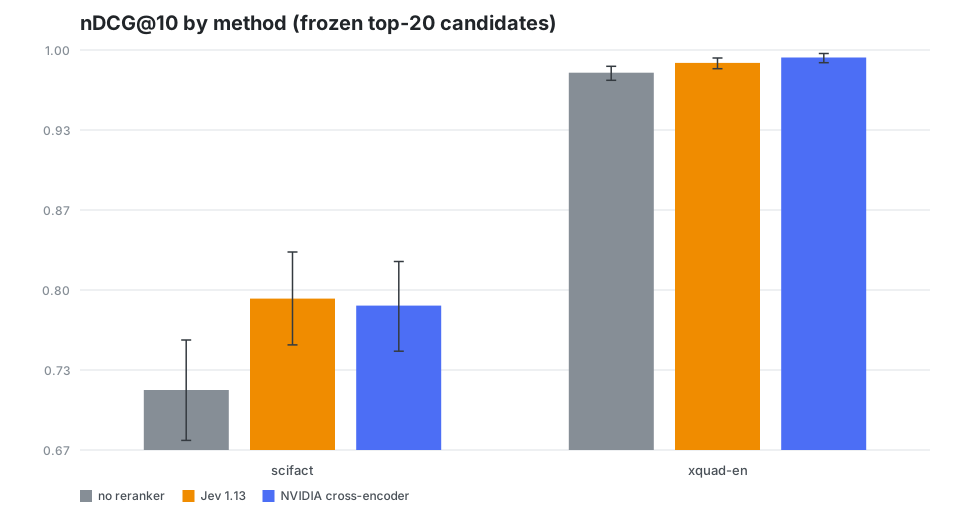
- Jev improves retrieval where there is headroom. +0.82 nDCG points over the unranked baseline on XQuAD (95% CI +0.35 to +1.31) and +7.62 on SciFact (CI +4.88 to +10.38).
- Against a trained cross-encoder: a tie on SciFact. +0.59 points, CI −1.25 to +2.42 — no measurable difference — while NVIDIA leads XQuAD by 0.45 points. Jev is not a universal ranker.
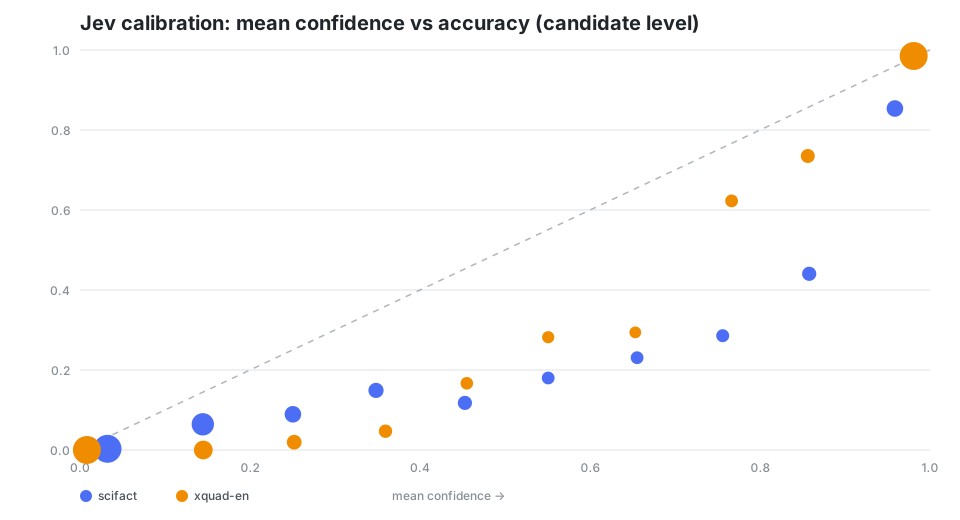
- Calibration is the sleeper feature. ECE 1.33% on XQuAD (6.25% on SciFact); top-1 confidence 0.96 when correct versus 0.74 when wrong. At p ≥ 0.7, precision is 94.9% against a 5% base rate — a 19x lift that a ranking metric alone would never show.
- Confidence-gated decisions beat the baseline everywhere. Partitioned reranking added +0.89 points on XQuAD (CI +0.45 to +1.36) and +4.14 on SciFact (CI +2.13 to +6.29); answerability gating removed 9.8% of generation calls while raising answer F1 from 30.6% to 31.3%.
- Every number above cost $0. Vercel AI Gateway free tier for Jev, NVIDIA NIM trial for embeddings and the cross-encoder, Codiv for generation. At list price the Jev calls would have been $0.33.
Bonus: tool-calling governance
Decision models can also govern tool calls: which tool to use, whether a call may run without review, whether arguments are valid, and whether observed text tries to manipulate the assistant. Same deterministic cases for all three: Jev through the Vercel free tier, Laya (open weights) through its official Hugging Face demo Space, and a free generative LLM asked for the same decisions as JSON.
| Task family (n = 40) | Jev 1.13 | Laya | LLM baseline |
|---|---|---|---|
| Tool selection, 5 tools | 100% | 100% | 100% |
| Tool selection, 20 tools | 90% | 100% | 80% |
| Tool selection, 50 tools | 70% | 40% | 70% |
| Tool selection, 200 tools | 80% | refused* | 80% |
| Call approval | 70% | 32.5% | 80% |
| Argument validation | 100% | 65% | 100% |
| Injection detection | 100% | 100% | 100% |
| Median decision latency | 1022 ms | 121 ms | 1018 ms |
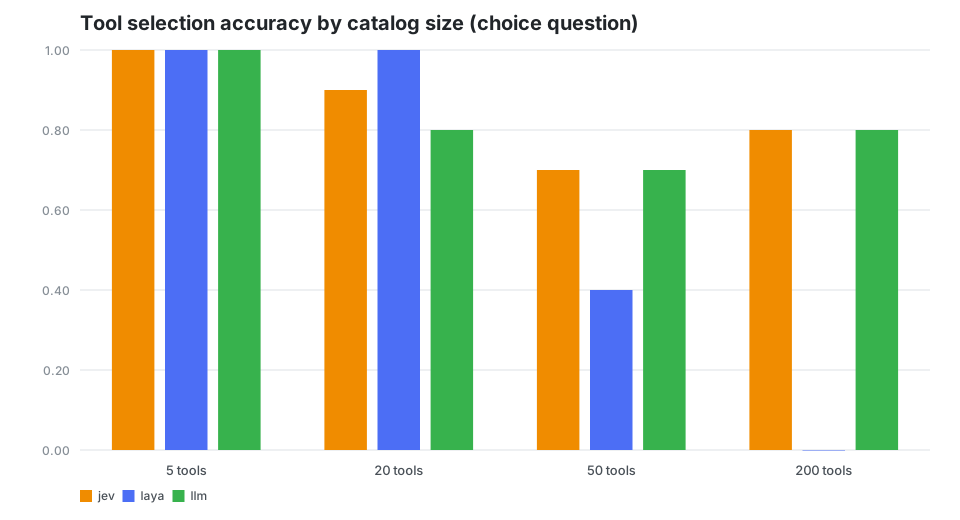
- Laya's 200-option result is a refusal, not a wrong answer.
Its English checkpoint rejects the question outright:
options do not fit in head_max_len=192 tokens. Degradation starts earlier — 40% at 50 options. - A free LLM matches Jev on accuracy here. Selection 82.5% vs 85%, approval 80% vs 70%, validation and injection tied at 100%. Jev's edge is operational: typed answers with no parsing, probabilities as a first-class API, many questions in one parallel request, input-only pricing.
- Fairness notes. Cases are synthetic and template-generated (one seed); Laya was served as its English base checkpoint; the LLM received the same state and questions with a JSON-only instruction; latency includes each hosted route (Laya's own reported model time is ~121 ms).
What failed
- Expecting gains everywhere. On XQuAD the baseline was already at 98.1% nDCG; there was almost nothing left to win, and always-on reranking added noise instead of value.
- Expecting to beat a trained cross-encoder. NVIDIA still leads XQuAD by 0.45 points; the honest summary is "useful decision layer", not "best ranker".
- Ignoring provider lifecycle. Three NVIDIA models were retired mid-run; the pipeline now pins versions and records every resolved model.
-
Expecting free-tier throughput. The gateway answered bursts with
429andRetry-After: 60; the run settled at roughly one request per second and checkpointed every 100 rows.
What I learned
- A benchmark's most valuable output is often the constraint map: where the model helps, where it does not, and what it must never be used for.
- For decision models, calibration is the product. Probabilities are what let a pipeline save money — ranking is just one consumer of them.
- Report latency with its conditions. Jev's 4-second median in the run is an artifact of free-tier pacing; a single request answered in 0.6 seconds. Publishing one number without the other would be misinformation.
- "No measurable difference" is a real finding. A trustworthy benchmark needs a home for it.